The Bitcoin bookshelf

Four books that explain why people care about hard money, from technology and deflation to the history of money. Summaries are our own.

ℹ️ Links on this page are plain links. If affiliate links are added later, blackiphy may earn a small commission at no extra cost to you.

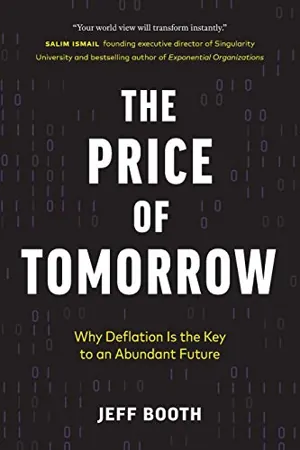
Cover of The Price of Tomorrow by Jeff Booth

Jeff Booth · about 6 h read

The Price of Tomorrow

Why Deflation is the Key to an Abundant Future

Booth argues that technology keeps pushing the cost of making things down, while a debt-based money system needs constant inflation to survive. He makes the case for hard money that lets falling prices reach people as abundance.

Key ideas
  • Technology is naturally deflationary.
  • Debt-based money needs continuous inflation, which widens inequality.
  • Falling prices from efficiency should be welcomed, not feared.
  • Hard money lets savers keep the gains from technology.
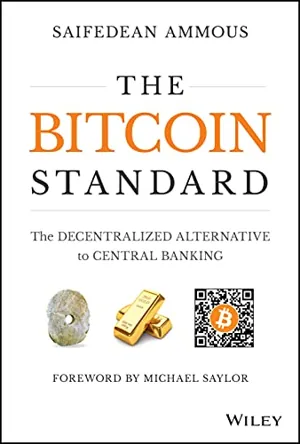
Cover of The Bitcoin Standard by Saifedean Ammous

Saifedean Ammous · about 8 h read

The Bitcoin Standard

The Decentralized Alternative to Central Banking

A history of money from shells and salt to gold and paper currency, arguing that societies do better on hard money and that Bitcoin's fixed supply makes it a candidate for a digital store of value.

Key ideas
  • Sound money encourages long-term thinking (low time preference).
  • Easy money lets governments run deficits at savers' expense.
  • Bitcoin's difficulty adjustment keeps new supply on a fixed schedule.
  • Scarcity on its own is not a guarantee of value; adoption matters.
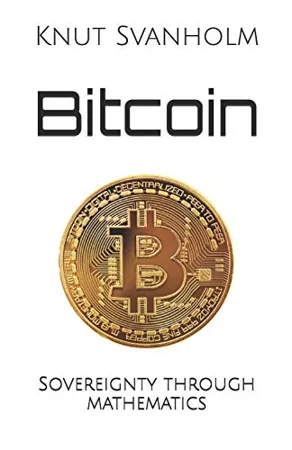
Cover of Bitcoin: Sovereignty through Mathematics by Knut Svanholm

Knut Svanholm · about 3 h read

Bitcoin: Sovereignty through Mathematics

Why Bitcoin is a discovery, not an invention

A short, philosophical look at digital scarcity, property rights and proof-of-work, and why the author thinks Bitcoin is closer to a discovery than an invention.

Key ideas
  • Bitcoin's rules are enforced by software and math, not by courts.
  • Proof-of-work ties digital scarcity to real-world energy.
  • Copies lack the original's network effect.
  • Self-custody is what makes the property rights real.
Cover of Gradually, Then Suddenly by Parker Lewis

Parker Lewis · about 5 h read

Gradually, Then Suddenly

A framework for understanding Bitcoin as money

An essay series, also published as a book, that explains money as a coordination tool and argues that monetary transitions happen slowly at first and then all at once.

Key ideas
  • Money coordinates time and resources; it isn't wealth itself.
  • Central planning of interest rates creates imbalances.
  • Fixed supply removes the dilution problem for savers.
  • Monetary change tends to be gradual, then sudden.